导图社区 FME2 Mindmap Week 9 2023
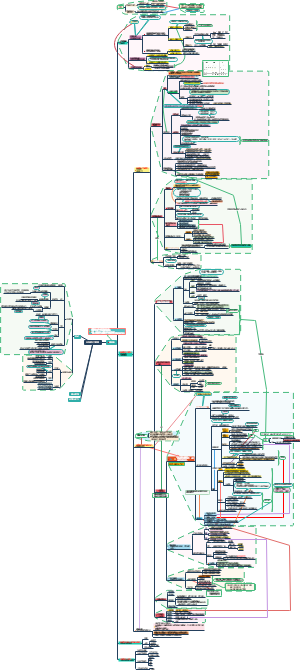
Probability Distributions:1. Ramdom Variables 2. Discrete Probability Distributions 3. Continuous Probability Distributions
编辑于2023-03-15 21:28:20 浙江省Probability Distributions
1. Ramdom Variables
1. A random variable (RV) is a numerical description of the outcome of an experiment. We use a capital X to denote random variables.
Random variables can be discrete or continuous.
2. If random variable is discrete, this means the outcomes of the experiment can be measured in integers (whole numbers). This can be between an interval, or infinite.
3. If a random variable is continuous, this means the outcomes of the experiment can take any value, it is not limited to integers. This can be between an interval, or a collection of intervals.
4. Discrete RV's
1. Expected value
1. We can calculate some descriptive statistics for random variables.
2. The mean, miu, of discrete random variables, is also called the Expected Value (E(X)). This is a measure of central tendency to see the average value of the RV.
3. This is the sum of the individual possible random variable values, denoted by the small x, multiplied by the probability, p(x), that random variable will occur.
2. Variance
1. We also need a measure of dispersion/ variablity for our random variable, to see how spread out the RV values are. To do this we can calculate the Variance (Var(X)).
2. This is the difference between the individual RV value and the mean, squared and then multiplied by the probability that RV values occur.
3. We also commonly use the standard deviation to measure dispersion. This is the positive sqaure root of the variance.
3. Example
4. Linear combinations of Discrete RV's
2. Sums of random variables
2. Discrete Probability Distributions
1. The probability distribution for a random variable descreibes how probabilities are distributed over the values of the random variable.
2. For discrete RV's, the probability distribution can be defined by a probability function, denoted by
3. The probability function describes the probability for each possible vcalue of the random variable.
4. Any probability function for a discrete random variable must satisfy two conditions
5. The simplest example for a discrete RV is the Uniform Probability Function
n= the number of values the random variable may assume.
6. Binomial probability distribution
1. Properties
1. The experiment consists of n identical trials.
2. All the trials are independent.
3. Each trial has two possible outcomes ,success or failure.
4. The probability of success, represented by π is the same in every trial. Consequently so is the probability of failure (1-π).
2. Conditional expectation

3. Continuous Probability Distributions
1. Continuous random variables can take any value and are not limited to integers.
2. Continuous probability distributions are probability distributions for continuous random variables.
3. Define continuous probability distributions through a probability density function.
4. The probability of the random variable occurring with an interval is the same as in any other equal sized interval.
5. Uniform probability distribution-continuous
6. Normal distribution
1. The normal distribution is the most important probability distribution for continuous random variables.
2. It has many practical applications including scientific measurements, test scores, amouts of rainfall, etc.
3. Properties
1. The normal distribution is characterized by a 'bell curve'.
2. The highest point on the curve is the mean. It is also the mode and median. The mean can take any value - negative, zero or positive.
3. The normal distribution is symmetric and the tails extend to infinity in both directions.
4. The area to the left of the mean is equal to 0.5 and to the right, 0.5.
4. Standard normal probability distribution
1. With the normal distribution, we commonly denote the random variable with a Z instead of X.
2. The standard normal distribution has a miu=0 and thita=1.
5. Calculating probabilities
1. The probability that the random variable Z will be less than or equal to a given value.
2. The probability that the Z will take a value between two given values.
3. The probability taht Z will be greater or equal to a given value.
6. Statistic Tables
4. We will start with the probability that Z<=a given value.
1. The information in the table represents the area to the left of any Z value in a standard normal distribution.
7. Other calculations
8. Converting to the standard normal distribution
X= any normal random variable