导图社区 RNA biosynthesis
- 70
- 1
- 0
- 举报
RNA biosynthesis
RNA的生物合成(转录)英文版,主要分为Template and enzyme of transcription in prokaryotes和The process of transcription in eukaryotes两部分。
编辑于2021-10-30 16:27:54- RNA bios…
- 相似推荐
- 大纲

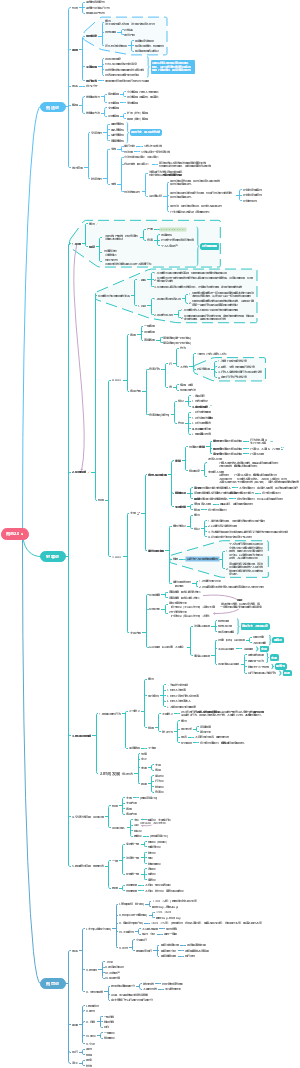
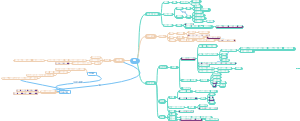
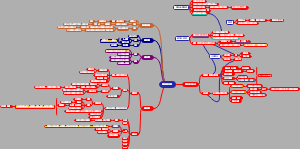
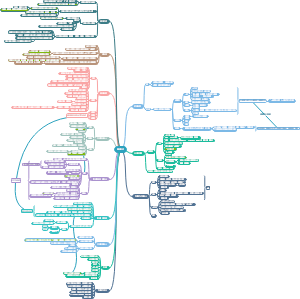
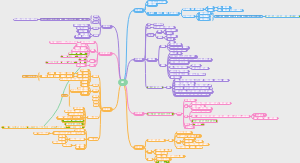
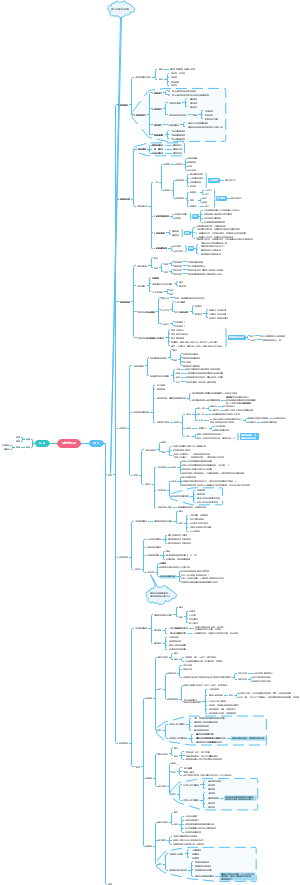
RNA biosynthesis
Template and enzyme of transcription in prokaryotes
The template of transcription
one of the two DNA strands in those segments
coding strand
template strand
Asymmetric transcription
only one of the two DNA strands serves as a template.
The template strand of different genes is not always on the same strand of DNA.
transcription orientation
5'---3'
The enzyme:RNApol
·Highest activity after binding dsDNA
Structure
Holoenzyme:2α,β,β’,w,σ
Holoenzyme catalyzes transcription initiation
σ:Identify the starting point
Core enzyme:2α,β,β’,w
Core enzyme catalyzes transcription elongation
chemical reaction
No need primer
Operon
consists of clustered numerous structural genes and upstream regulatory sequences. It is prokaryotic transcription units
promoter
binding sites of RNA pol and DNA template to initiate transcription
How to determine the sequence of the promoter?
RNA polymerase protection method
Promoter in prokaryotes
-35region:TTGACA
-10region:TATAAT(pribnow box)
function:Promoter determines transcription direction and basic transcription level.
The transcription process
initiation
step
Step 1: A closed transcription complex is formed.
Step 2: An open transcription complex forms in succession.
Step3: the formation of the first 3’,5’- phosphodiester bond
points
Holoenzyme required
Primer not required
First nucleotide often is GTP/ATP: 5’-pppGpN-OH3’
Eelongation
1.Promoetr clearance
Abortive initiation is overcome
The σ subunit dissociates as the first ~10nt of new RNA are synthesized. (holoenzyme → core enzyme)
RNA pol leaves the promoter to elongate RNA
2.Transcription bubble
RNA pol generally keeps ~17 bp DNA unwound
The DNA/RNA heteroduplex is short (~8bp) and transient.
G≡C > A=T > A=U
features
Core enzyme
A=U
5’→3’ elongation
Form transcription bubble (Dynamic 8 bp RNA-DNA hybrid)
Coupled transcription and translation
Coupled transcription and translation in prokaryotes
one gene usually is transcribed by many molecules of RNA polymerasesimultaneously.
Each mRNA is being translated by many ribosomes simultaneously
Termination
ρ-dependent termination
Rho factor(ρ)
RNA binding protein.
Rho factor consists of 6 units, each weighs 46kD.
High affinity for transcript RNA especially for polyC.
ATPase: hydrolyzes ATP
Helicase: disrupts the RNA-DNA hybrid by hydrolysis of ATP
Features
The ρ-dependent terminators usually include a CA-rich sequence called a rut (rho utilization) element.
rut sequence locates at 3’ end of RNA.
The ρ protein associates with the RNA at rut site.
The processs
The ρ helicase binds to a rut site
The ρ helicase migrates along the mRNA to the elongatingRNA polymerase
The ρ helicase separates the mRNA from the DNA temple
ρ-independent termination
Features
a region producing an RNA transcript with self-complementary sequences, permitting the formation of a hairpin structure near 3’ end of the RNA strand.
a highly conserved string of A residues in the template strand that are transcribed into string of U residues near the 3’ end of the hairpin
The process
Hairpin disrupts part of the RNA-DNA hybrid.
Hybrid duplex contains a particularly unstable base pairing (A-U)
The process of transcription in eukaryotes
Eukaryotic RNA pols
RNA pol Ⅱ
12 subunits
The largest RPB1 subunit has C-terminal domain
CTD
a long tail consisting of many repeats of a consensus AAs: Tyr-Ser-Pro-Thr-Ser-Pro-Ser
Unphosphorylated CTD:---initiation
Phosphorylated CTD ---elongation
RNA pol Ⅱ requires an array of general TFs to form the active transcription complex
Cis-acting element
Core promoter: TATA box (Hognest box), -30~-25bp
Upstream element: CAAT box, GC box, -200~-70bp
Distant regulatory sequence: enhancer, silencer
Transcription factor (TF)
Trans-acting factor: recognizes and binds with cis-acting element directly or indirectly
TF classification
general TF:
binds to RNA-pol directly or indirectly
specific TF:
mediator, upstream factor
TF name
TFI, II, III for RNA pol I, II, III
function of TFⅡ
TBP
Specifically recognizes the TATA box
TFⅡA
Stabilizes binding of TFIIB and TBP to the promoter
TFⅡB
Binds to TBP; recruits Pol II–TFIIF complex; accurately positions pol II at the TSS;
TFⅡD
Required for initiation at promoters lacking a TATA box
TFⅡE
Recruits TFIIH; regulate its ATPase and helicase activities
TFⅡF
Binds tightly to Pol II; binds to TFIIB and prevents binding of Pol II to nonspecific DNA sequences
THⅡH
Unwinds DNA at TSS (helicaseactivity);phosphorylates CTD at Ser5 ; releases Pol II from the promoter; recruits nucleotideexcision repair protein
The transcription process
Initiation
1. Formation of a closed preinitiation complex (PIC)
2.Creating an open complex. TFIIH: DNA helicase
3: RNA strand initiation and promoter clearance.
TFIIH: kinase
Conformational change in the overall complex initiating transcription.
After synthesis of 60 to 70 nt, TFIIE and TFIIH release, and RNA pol II enters the elongation phase of transcription
Elongation
nuclear membrane
transcription and translation proceed asynchronously
chromatin
nucleosome depolymerization
Transcription elongation promoted by the RNA pol II
Termination
Coupled with posttranscriptional modification
The site of cleavage/polyadenylation: an upstream AAUAAA motif and a downstream U-rich or GU-rich element
Post-transcriptional processing and degradation of eukaryotic RNA
1. Processing of hn-RNA/pre-mRNA to produce mature-mRNA
Capping on the 5ʹ end
Function of Cap
Bind with cap-binding complex of protein(CBC).
Prevent from degradation by the 5′ to 3′ exonuclease.
Participates in exportation from the nucleus.
Participates in translation initiation.
The formation process
Polyadenylation of the 3ʹ end
Function of polyA
Bind with polyA-binding proteins (PABP).
Prevent from degradation by the 3′ to 5′ exonuclease.
Participates in exportation from the nucleus.
Participates in translation initiation.
The formation process
Eukaryotic pre-mRNA splicing
Split gene
It is the eukaryotic structural gene on which the coding regions (exons) are often interrupted by the noncoding regions (introns). After splicing of introns and connecting exons again, it become mature RNA.
Introns
• Introns are the intervening nucleotide sequences in the structural gene and its pre-RNA that are removed from the primary transcript when it is processed into a mature RNA
Exons
Exons are the sequences that are presented in split genes and mature RNA molecules, and they encompass not only protein-coding genes but also the genes for various RNA (such as tRNAs or rRNAs)
Pre-mRNA splicing
snRNA
U1,U2,U4,U5,U6
rich in uridine, 100-300nt
snRNPs
snRNA+proteins
involved in mRNA splicing
Splicing mechanism of pre-mRNA in spliceosome
The U1 snRNA base pairs with 5’ splicing junction.
The U2 snRNA forms base pairs with the A site.
The U4/U6-U5 “triple” snRNP positions the
The U4/U6-U5 “triple” snRNP positions the appropriate portions of the hnRNA for the following splicing reaction
Rearrangement of snRNP to form active spliceosome
Splicing of introns
Introns are removed as lariat
Other processing in precursor mRNA
Alternative cleavage & polyadenylation site
Alternative splicing
Alternative cleavage & polyadenylation site + Alternative splicing
2. post-transcriptional processing of rRNA
eukaryotic 45S precursor rRNA into three rRNAs.
RNaseP
RNaseD/Z
子主题
3. post-transcriptional processing of tRNA
Cleavage, addition of CCA-OH at 3’end
Base modification
Splicing (enzyme-catalyzed)