导图社区 organic chemistry2019-10-05
- 212
- 5
- 0
- 举报
organic chemistry2019-10-05
注释了超级多内容。欢迎双语教学,全英教学的朋友一起学习。我会每周维护有机化学导图,并且在周日晚上发布最新版。搜索organic chemistry哦
编辑于2019-10-05 16:48:26
- 相似推荐
- 大纲

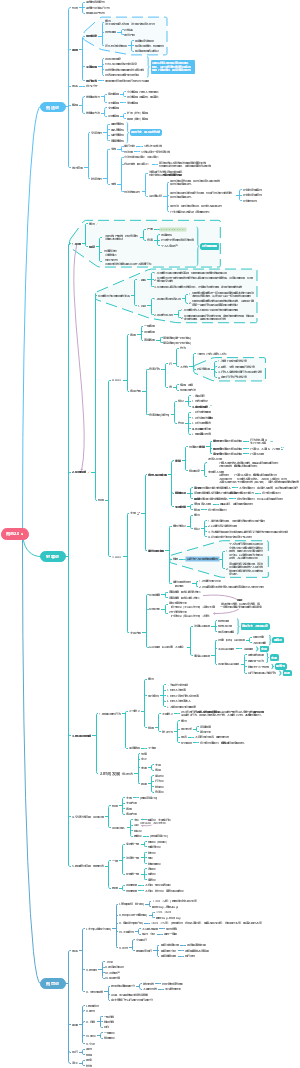
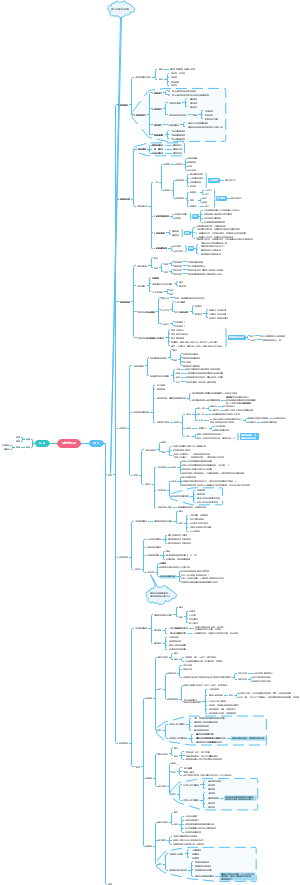
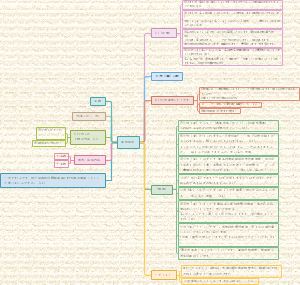
Organic chemistry
intermolecular force
neutral molecule
properties
b.p.
down as chain branching increases
surface area
m.p.
solubility
Dipole-dipole interactions

result from
the approach of two polar molecules.
Dispersion forces
london forces or fleeting dipole-dipole force(本质) 
depends on
close surface contact
branches decrease the surface contact between molecules
Larger molecules has more surface area
fleeting瞬间 dipole-dipole force
Hydrogen bonding(最强)
H bond strength typically around 20kJ/mol typical single bonds around 400kJ/mol the hydrogen from one molecule is strongly attracted to a lone pair of electrons on the oxygen/nitrogen of another molecule
not a true bond
a particularly strong dipole–dipole attraction
ENtive
O-H more polar than N-H,so alcohols have stronger hydrogen bonding
nomenclature
Stereoisomerism
/,steriəuai'sɔmərizəm, ,stiə-/立体异构现象 indicates whether double bonds are cis/trans, and indicates stereocenters (R, S), which we will cover in the chapter on configuration. We cannot use cis/trans terminology to differentiate them, because we don’t have two identical groups to compare. cis/trans nomenclature can be used only when we have two identical groups.  are not the same If we have two identical groups connected to the same atom, then we cannot have stereoisomers. 
cis
identical groups are on the same side of the double bond 
trans
identical groups are on the opposite side  The two groups that we compare can even be hydrogen atoms trans
R
S
Substituents
are groups coming off of the main chain
halogen
Halogens are named as substituents in the following way: fluoro, chloro, bromo, and iodo.
F C B I
Parent
is the main chain
functional group
double bond
triple bond
Unsaturation
identifies if there are any double or triple bonds. Notice that “an” is used to indicate the absence of a double bond or triple bond, such as in “pentane”
Functional group
This is the group after which the compound is named. When a compound has one of these six groups, we show it in the name of the compound by adding a suffix to the name how do you name the functional group when you have two functional groups in a compound? One will go in the suffix of the name and the other will be a prefix in the substituent part of the name. But how do we choose which one goes as the suffix of the name?
structure and bonding
atom structure
nucleus  electron cloudm the unit angstrom (A) is m =100 pm
atomic number
the number of the protons in the atomic nucleus.
atomic mass number
the number of the protons plus neutrons all the number of a given element have the same atomic number atomic mass=atomic weight of an element is the weighted average mass in atomic mass units(amu)of an element's naturally occuring isotopes
isotope
atoms of the same element that have different numbers of neutrons and therefore different mass numbers
electronic structure
shell
OA
density
the electron density is highest at the nucleus and drops off exponentially with increasing distance from the nucleus in any direction 
node
2s orbital has zero electron density called a node 
Wave Interactions
 different atoms is bond formation on the same atom is hybridization waves that are in phase add together, amplitude increases waves that are out of phase cancel out
electron configuration
aufbau principle
fill the lowest energy orbitals first
pauli exclusion principle
each orbital can hold a maximum of two electrons, provided that their spins are paired/orientations of spins are reverse
hund's rule
that for two or more orbitals of the same energy(degenerate), electrons will go into different orbitals rather than pairing up in the same orbital
bonding
ionic bonding
bearing opposite charges, stay together by electrostatic attraction
covalent bonding
nonpolar
when the electrons are shared evenly the bond is said to be nonpolar or pure covalent
polar
when the electrons are not shared evenly the bond is said to be polar
sigma bonding
the bonding molecular orbital (MO) is lower in energy than the original atomic orbitals the antibonding MO is higher in energy than the original atomic orbitals.  
bond patttern

lewis dot structure
ENtivity
 C-H considered to be non-polar
bond polarity
dipole moment
formal charge
octet
子主题
Isomerism
Constitutional isomers
Stereoisomers
Geometry
orbitals and hybridization states
If the sum is 4, then you have 4 sp3 orbitals. If the sum is 3, then you have 3 sp2 orbitals and one p orbital (as in our example). If the sum is 2, then you have 2 sp orbitals and two p orbitals. Do not forget to count the hydrogen atoms (they are not shown).
geometry
the valence shell electron pair repulsion theory (VSEPR). 
tetrahedral
trigonal planar
linear
trigonal pyramidal
bent
Acid-Base reaction
Bronsted-Lowry acid-base theory
conjugate acid-base
酸碱对 (acids give protons and bases take protons). Since A" is the base that we get when we deprotonate HA, we call A" the conjugate base of HA.  →how can we tell whether or not HA is willing to give up its proton?/how much is HA willing to give up its proton? (indentify weak/strong acid)v looking at the conjugate base. → how stable is that negative charge? If that charge is stable, then HA will be willing to give up the proton, and therefore HA will be a strong acid. If that charge is not stable, then HA will not be willing to give up its proton, and HA will be a weak acid. So you only need one skill to completely master acid–base chemistry: you need to be able to look at a negative charge and determine how stable that negative charge is.
how stable that negative charge is.
remember the rank of four factors  remove the proton draw the resulting conjugate base  compare by two factors O is more acidic
what atom is the charge on
Factor1  How do we compare these? electronegativity we need to consider two trends: comparing atoms in the same rowand comparing atoms in the same column:  F is more electronegative than I , but less stable than I (Scroll down) there is another more important trend when comparing atoms in the same column: the size of the atom. Iodine is huge compared to fluorine. So when a charge is placed on iodine, the charge is spread out over a very large volume. When a charge is placed on fluorine, the charge is stuck in a very small volume of space:  Even though fluorine is more electronegative than iodine, nevertheless, iodine can better stabilize a negative charge. conclusion Sulfur is larger than oxygen, so sulfur can better stabilize the negative charge.
electronegativity
for comparing atoms in the same row
size
for comparing atoms in the same column The first factor (comparing atoms in the same row) is a much stronger effect. In other words, the difference in stability between C" and F" is much greater than the difference in stability between I" and F".
resonance
 So we cannot use factor 1 (what atom is the charge on) to determine which proton is more acidic. In both cases, we are dealing with a negative charge on oxygen.   Even though carbon is not as happy with a negative charge as oxygen is, nevertheless, it is better to spread the charge over one oxygen and three carbon atoms than to leave the negative charge stuck on one oxygen. Spreading the charge around helps to stabilize that charge 1. The more delocalized the better. A charge spread over four atoms is more stable than a charge spread over two atoms, but 2. One oxygen is better than many carbon atoms.
induction
一般是看 电负性强的原子与烷基  Factor 1 does not answer the problem: in both cases, the negative charge is on oxygen. Factor 2 also does not answer the problem: in both cases, there is resonance that delocalizes the charge over two oxygen atoms. induction: difference electronegativity creates a difference in the electron density on the two atoms—the oxygen atom becomes electron rich and the carbon atom becomes electron poor. This “pulling” of electron density is called induction But what effect do carbon atoms have (alkyl groups)?  alkyl groups are electron donating  In the structure on the left, the charge is somewhat stabilized by the inductive effects of the neighboring chlorine atoms. In contrast, the structure on the right is destabilized by the presence of methyl groups. Therefore, the structure on the left is more stable.
orbital
 a lone pair of electrons residing in an sp orbital will be held closer to the positively charged nucleus and will be stabilized by being close to the nucleus.
exception
 For this reason, NH2" can be used as a base to deprotonate a triple bond. 用于去质子化什么东西,意味着能发生类似酸碱中和反应
quantitative management(p K a values)
The smaller the pKa, the more acidic the proton is.
predicting the position of the equilibrium
predict which side of an equilibrium will be favored  there will be a certain number of A’s that have a proton (HA) and a certain number of B’s that have a proton (HB). These numbers are controlled by the equilibrium
show the mechanism
we are allowed to break single bonds, because we are using arrows to show how a reaction happened ,never violate the octet rule—is still true  Remember—2 arrows. One from the base to the proton and the other from the bond (that is losing the proton) to the atom (currently connected to the proton 化学方程式的右边完全不用动
resonance structure
two commandments;three steps;five patterns;three rules 
draw arrow in given resonance structure
drawing the resonance structures not given
1.read arrows
2.don't forget formal charge on the new drawing
Structures drawn without them are wrong
three steps
这三个点必须按顺序且都考虑到 using curved arrows to draw resonance structures. determining valid resonance structures
converting lone pairs into pi bonds
converting pi bonds into pi bonds
converting pi bonds into lone pairs
five patterns
drawing resonance structure by recognizing patterns
A lone pair next to a pi bond.
“Next to” means that the lone pair is separated from the double bond by exactly one single bond—no more and no less. In each of these cases, you can bring down the lone pair to form a pi bond, and kick up the pi bond to form a lone pai.  When the atom with the lone pair does not have a negative charge to begin with, then it will end up with a positive charge in the end, while a negative charge will go on the atom getting the lone pair in the end (remember conservation of charge)  Notice that the lone pair needs to be directly next to the pi bond. If we move the lone pair one atom away, this does not work anymore:
A lone pair next to a positive charge.
In each case, we can bring down the lone pair to form a pi bond: Notice what happens with the formal charges. When the atom with the lone pair has a negative charge, then the charges end up canceling each other  When the atom with the lone pair does not have a negative charge to begin with, then it will end up with the positive charge in the end and form a double bond (remember conservation of charge):  There is one situation when we cannot combine charges to give a double bond: the nitro group. The structure of the nitro group looks like this:  the nitrogen atom would have five bonds, which would violate the octet rule.
A pi bond next to a positive charge
When this happens, we push each of the double bonds over, one at a time:  It is not necessary to waste time recalculating formal charges for each resonance structure, because the arrows indicate what is happening. Think of a positive charge as a hole (a place that is missing an electron).When we push electrons to plug up the hole, a new hole is created nearby. In this way, the hole is simply moved from one location to another. Notice that the tails of the curved arrows are placed on the pi bonds, not on the positive charge. Never place the tail of a curved arrow on a positive charge (that is a common mistake).
A pi bond between two atoms, where one of those atoms is electronegative
In cases like this, we move the pi bond up onto the electronegative atom to become a lone pair:  Notice what happens with the formal charges. A double bond is being separated into a positive and negative charge (this is the opposite of what we saw in the second pattern we looked at, where the charges came together to form a double bond).
Pi bonds going all the way around a ring.
It does not matter whether we push our arrows clockwise or counterclockwise (either way gives us the same result, and remember that the electrons are not really moving anyway). 
three rules
assessing the relative importance of resonance structure One compound might have three resonance structures, but all three resonance structures might not contribute equally to the overall resonance hybrid. One resonance structure might be the major contributor (like the peach), while another resonance structure might be insignificant (like the kiwi). In order to understand the true nature of the compound, we must be able to compare the resonance structures and determine which structures are major contributors and which structures are not significant. there are three rules for determining which resonance structures are significant(意义重大的;有效的). significant 在这里亦表示贡献度高的
Minimize charges.
The best kind of structure is one without any charges. limiting charge separation to no more than two charges 特例: We must draw the nitro group with charge separation. Therefore, the two charges of a nitro group don’t really count when we are counting charges. Consider the following case as an example:  If we apply our rule (about limiting charge separation to no more than two charges), then we might say that the second resonance structure above has too many chargesto be significant. But it actually is significant, because the two charges associated with the nitro group are not included in our count. We would consider the resonance structure above as if it only had two charges, and therefore, it is significant.
ENtive atoms can bear a positive charge only possess an octet of electrons.
Electronegative atoms (such as N, O, Cl, etc.) ENtive指的是:electronegative  The second resonance structure above is the most significant. In the first structure, oxygen has its octet, but carbon only has 6 electrons. In the second resonance structure, both oxygen and carbon have their octet. This makes the second resonance structure more significant, even though the positive charge is on oxygen.   the second resonance structure has an oxygen with a positive charge. But this oxygen does not have its octet, and therefore, this resonance structure is not significant. O
Avoid drawing two carbon atoms bear opposite charges.
 The presence of carbon atoms with opposite charges, whether close to each other (as in the example above) or far apart, renders the structure insignificant. only carbon
comparison
Has as many octets as possible
 
Has as many bonds as possible.
Has the negative charge on the most electronegative atom

Has as little charge separation as possible
注意看H
priority