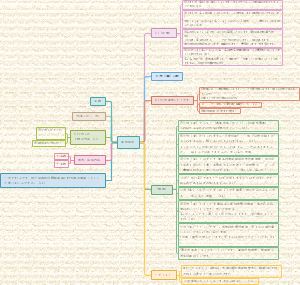
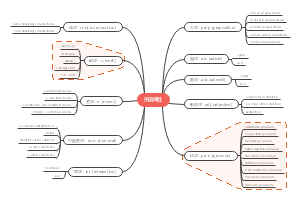
导图社区 化学动力学(Chapter 5)
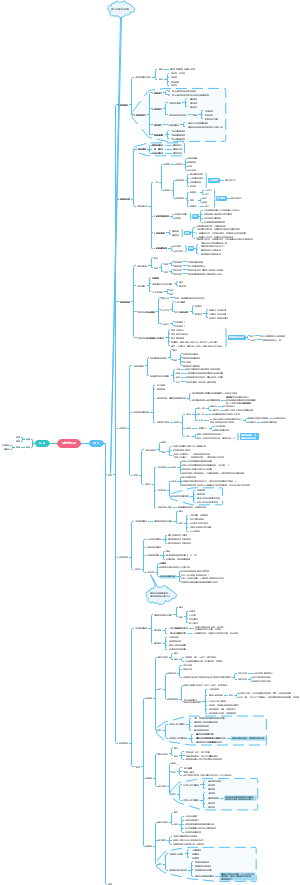
这是一篇关于化学动力学(Chapter 5)的思维导图,主要内容包括:Rates of Chemical Reaction。
编辑于2024-11-06 19:39:53化学动力学(Chapter 5)
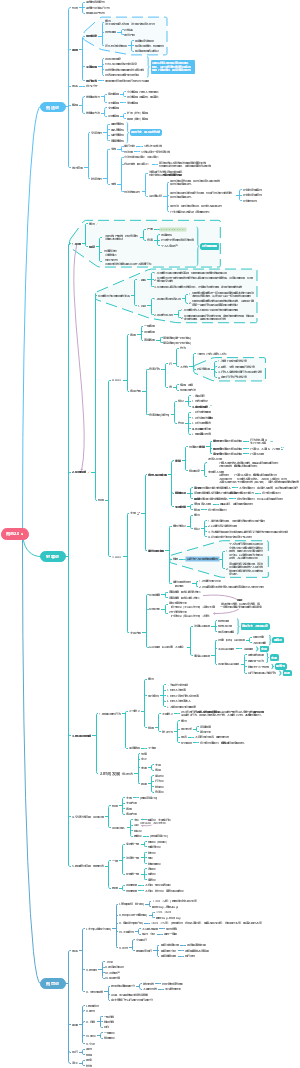
Rates of Chemical Reaction
5-1 Rates and Mechanisms of Chemical Reactions
5-1.1 The Rate of Chemical Reaction
the decrease in concentration of a reactant
increase in concentration of a product in a unit of time.
units
average reaction rate
Instantaneous rate:
5-1.2 The Mechanisms of Chemical Reactions
Reaction Mechanisms
a description of the path that a reaction takes.
Overall reaction
A reaction was completed through several elementary reactions.
Elementary reaction(基元反应):
A reaction can complete directly by only one step or reactants can convert into products.
unimolecular
bimolecular
termolecular
5-2 Theories of Reaction Rate
5-2.1 Collision Theory and Activation Energy
Contents of Collision Theory
⑴ reacting molecules must come so close that they collide.
⑵ not every collision between molecules creates products, only few collisions between reactant molecules will react.
⑶ enough energy; proper orientation
For a collision to result in reaction, the molecules must be properly oriented.
Collisions must occur with enough energy to break the bonds in the reactants so that new bonds can form in the products.
活化理论
•Activation molecule
is the molecule have enough energy and can produce effective collision
activation energy (Ea) :
The minimum energy of a collision that leads to a reaction.
Figure: As the activation energy of a reaction decreases, the number of molecules with at least this much energy increases, as shown by the yellow shaded areas.
5-2.2 The Transition StateTheory
Transition state theory (TST)(activated complex theory.)
reactants pass through high-energy transition states before forming products, they are associated in an unstable entity called an activated complex, then change into products.
5-3 Reaction Rates and Concentrations
5-3.1 The Rate Law
① when [A]=[B]=1mol·L-1 , v=k
② the greater the k , the faster the rate
③ m and n must be determined experimentally, in general, m and n are not equal to the stoichiometric coefficients a and b
5-3.2 Order of A Reaction
m is the order of the reaction with respect to A
n is the order of the reaction with respect to B.
The overall order of the reaction is the sum of m and n
• First-order reactions
• Second - order reactions
A,B初始浓度为一样
• Zero - order reactions
5-4 Effect of Temperature on Reaction Rates
5-4.1 Rule of Thumb ( Van ’ t Hoff Law)
5-4.2 The Arrhenius Equation
5-4.3 Application of Arrhenius Equation
5-5 Effect of Catalyst on Reaction Rates
• Catalyst:
is a substance that increase the rate of a chemical reaction without itself being consumed (changed).
The features of catalysts
• No change of mass and composition
• Selective
• Small amount can have big action
• Not only speed forward reaction but also speed reverse reaction ( effect velocity , not effect equilibrium constant )
three types:
Homogeneous catalysis
Heterogeneous catalysis
Enzyme Catalysis
Gentle
High efficient
High selective (special)
The characteristics of zero-order reactions:
1. A graph of c against t is a straight line
2. The rate constant, k, has units of [c][t]-1;
3. The half-life of a zero-order reaction is t1/2=0.5c0 /k.
The characteristics of second- order reactions:
1. A graph of 1/c against time is a straight line , the slope of which gives the rate constant for the reaction;
2. The rate constant, k, has units of [c]-1[t]-1;
3. The half-life of 2th-order reactions
The characteristics of first-order reactions:
1 . A plot of logc versus t (time) gives a straight line with a slope of -k/2.303
2. The rate constant, k, has units of [time]-1 .
3. half-life (t1/2) :
effective collision: a collision that leads to a reaction